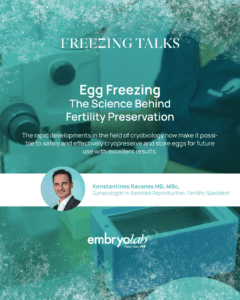
The goal of fertility preservation methods is to maintain reproductive capacity and postpone parenthood until the future. The rapid developments in the field of cryobiology now make it possible to safely and effectively cryopreserve and store eggs for future use with excellent results.
Who is it for?
- Women who are delaying motherhood for social, professional, or personal reasons
- Women with a family history of premature ovarian insufficiency.
- Women who are about to undergo
- oncological treatments, such as surgery,
- radiation, or chemotherapyακτινοβολίες ή χημειοθεραπεία.
- Women with endometriosis.
The Stages of the Procedure
- Consultation with a Fertility Gynecologist Specialist.
The goal is to personalize the procedure by customizing the medication protocol and the
prognostic success models of the method, which will be based on:
- The individual and family medical history.
- The woman’s specific physical and psychological needs
- Laboratory and imaging tests related to the ovarian reserve of eggs, including the
calculation of the Anti-Müllerian Hormone (AMH) and the Antral Follicle Count (AFC).
- Ovarian Stimulation and Egg Retrieval
The woman undergoes pharmaceutical ovarian stimulation with hormones for 10–12 days to promote the development and maturation of multiple follicles. The treatment is absolutely controlled and guided by the treating physician. Egg retrieval is performed via a minor vaginal surgical procedure under ultrasound guidance and sedation, ensuring the process is completely safe and woman-friendly.
- Egg Cryopreservation and Storage
This is performed using vitrification, the most modern and effective method for the cryopreservation of genetic material. Specifically, it allows for the ultra-rapid freezing of the eggs into a glassy (vitreous) state, preventing the formation of intracellular ice and crystals through the use of special cryoprotective molecules. The eggs are then placed in special vials which are immersed directly in liquid nitrogen at -196°C, where they are stored for a long period (cryobank). Our unit, EMBRYOLAB, was among the first to implement this technique in Greece, utilizing state-of-the-art equipment.
Conclusion
With appropriate medical guidance, egg freezing is a safe and effective method of fertility preservation that increases flexibility in family planning.
Frequently Asked Questions
How many eggs should be cryopreserved?
The success of the method depends on the number of eggs and the woman’s age at the time of cryopreservation, with the best results recorded between the ages of 25 and 36, though this does not mean that older ages cannot proceed with this process. Statistically, based on prognostic models, as age increases, the quality of the eggs decreases, resulting in the need to retrieve more eggs to achieve a normal pregnancy.
Is it a safe procedure?
The use of vitrification has provided excellent results with egg survival approaching 100%. The quality and fertilization capacity of the eggs are not affected by the duration of cryopreservation. Large epidemiological studies have shown that there is no increased risk of obstetric complications and genetic abnormalities in children born from the use of cryopreserved eggs1. Furthermore, the use of hormonal medications for ovarian stimulation does not de novo increase the risk of breast
and ovarian cancer compared to the general population2.
Bibliography
- Six-year follow-up of children born from vitrified oocytes Yuya Takeshige 1, Mizuho Takahashi 2, Tomoko Hashimoto 1, Koichi Kyono 3 Reprod Biomed Online 2021 Mar;42(3):564-571
- Fertility drugs and cancer: a guideline.(ASRM). Fertil Steril. 2024 Sep;122(3):406-420. doi: 10.1016/j.fertnstert.2024.03.026. Epub 2024 May
- PMID: 38703170